
Projects created and developed by Denis Karagodin and currently advanced as part of his ongoing research and creative work.

Investigation
KARAGODIN® Investigation (Расследование КАРАГОДИНА®) [KARAGODIN.ORG] (RU / EN) [since 2012] — Founder & CEO.
More Info
The KARAGODIN® Investigation is an independent historical investigation into Soviet political repression, documenting the execution of Stepan Karagodin in 1938 and identifying individuals responsible through archival and documentary evidence.
The investigation is methodologically oriented toward establishing legal and political accountability for those involved, positioning the project as a rare example of a historically grounded inquiry that seeks not only to reconstruct past events but also to address their legal and institutional implications in the present.
A distinctive feature of the project is its methodological focus on the interaction between temporality and bureaucratic structures. By working with archival time, administrative procedures, and contemporary media environments, the investigation treats documentation not only as historical evidence but also as an active medium through which political narratives, institutional responsibilities, and present-day realities can be examined and articulated in the public sphere.
In this sense, the project operates not only as a historical inquiry grounded in a personal family history but also as a structured institutional intervention, actively producing new frameworks of accountability and contributing to the formation of legal, institutional, and political realities through which the legacy of state violence and questions of historical responsibility are addressed in practice.
Read more:
KARAGODIN® Investigation — White Paper.
White Paper
This document establishes a structured conceptual, methodological, and analytical framework for the KARAGODIN® Investigation.

Podcast
KARAGODIN® Investigation Podcast / Подкаст Расследование КАРАГОДИНА® [since 2020] – Founder & CEO.
More Info
The KARAGODIN Investigation Podcast is developed as a media extension of the KARAGODIN® Investigation project. The podcast presents research materials, archival discoveries, and analytical reflections emerging from the investigation, translating its historical and methodological work into a narrative and documentary audio format.
More than a conventional storytelling series, the podcast functions as a hybrid media platform and a laboratory for the project’s philosophical and methodological approach. By combining archival research, analytical commentary, and narrative structure, the series explores new ways of presenting complex historical material and communicating the investigative method developed within the project.
Within the broader framework of the KARAGODIN® Investigation, the podcast therefore operates not only as a narrative format but also as a media instrument through which the project expands its public presence and develops new forms of intellectual and institutional intervention.
Work in progress…

Literary genre
STEPINQUEST®
STEPINQUEST® — a literary genre developed by Denis Karagodin as part of the KARAGODIN® Investigation project.
More Info
STEPINQUEST® is a literary, narrative, and investigative framework developed by Denis Karagodin within the KARAGODIN® Investigation project. Emerging from the methodological structure of the investigation itself, STEPINQUEST® represents a distinctive narrative form in which historical inquiry unfolds step by step through archival research, analytical reconstruction, and the public documentation of evidence. In this sense, STEPINQUEST® may also be understood as a literary genre that arises from the direct integration of investigative practice and narrative reconstruction.
The term combines the words step and inquest, reflecting both the procedural progression of the investigation and the legal concept of an inquest understood as a formal inquiry into the circumstances of death. At the same time, the name implicitly references Stepan Karagodin, whose execution during the Stalinist repressions became the initiating case of the investigation.
Unlike conventional true crime or investigative storytelling, STEPINQUEST® is defined by the direct interaction between narrative reconstruction and real institutional processes. The development of the narrative is inseparable from the investigative work itself and may produce legal, political, or institutional consequences as new evidence is uncovered, documented, and publicly presented.
Within the KARAGODIN® Investigation, STEPINQUEST® functions as a methodological narrative framework used for presenting research materials, documenting the progress of the investigation, and structuring its public communication across texts, podcasts, and other media formats. In this sense, STEPINQUEST® represents not only a form of storytelling but also a systematic approach to documenting historical crimes, where archival evidence, narrative reconstruction, and institutional accountability intersect.
Beyond the specific context of the KARAGODIN® Investigation, STEPINQUEST® also proposes a broader model for investigative narrative practice. The framework describes a form of inquiry in which complex events are reconstructed step by step through the systematic accumulation of documentary evidence, analytical interpretation, and public documentation of the investigative process. In this sense, STEPINQUEST® may be applied not only to historical cases but also to contemporary investigations where unresolved events — such as institutional failures, miscarriages of justice, or large-scale public incidents — require renewed examination. By combining narrative reconstruction with legal, archival, and methodological rigor, the STEPINQUEST® approach establishes a structured investigative process capable of revisiting official conclusions and producing new interpretations grounded in documented evidence.
The STEPINQUEST® framework also highlights the potential role of independent researchers and civic initiatives in the process of investigative reconstruction. By providing a structured methodology for collecting, analyzing, and publicly documenting evidence, the approach may be applied not only within institutional contexts but also by individuals and independent investigative efforts working in the public interest. In this sense, STEPINQUEST® may also serve as a narrative and methodological model for writers, journalists, and public-interest investigators seeking to structure complex inquiries through a step-by-step process of documentary analysis and narrative reconstruction. By offering a clear investigative architecture, the STEPINQUEST® approach helps formalize and communicate complex investigative work, enabling both institutional and non-institutional actors to revisit unresolved events and contribute to the clarification of historical or contemporary cases.
The concept continues to be developed and articulated within the KARAGODIN® Investigation project.
Read more:
STEPINQUEST® — White Paper.
White Paper
This document introduces an investigative narrative genre in which storytelling functions as action, integrating evidence, analysis, and intervention into a single process.
Book
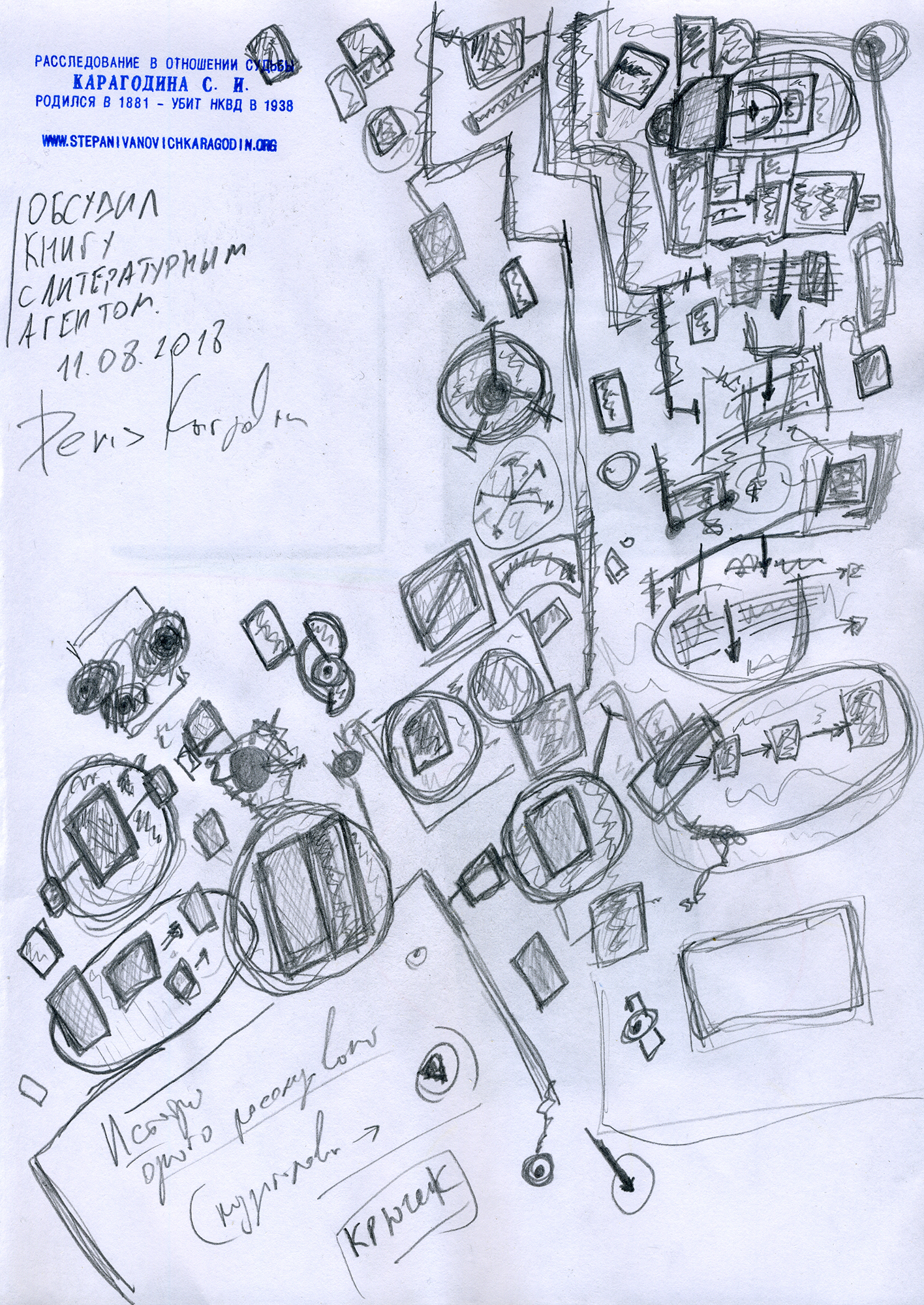
A book documenting the KARAGODIN® Investigation
More Info
A book documenting the KARAGODIN® Investigation and examining the emergence and development of the project as a unique historical, methodological, and public phenomenon.
The book reconstructs the course of the investigation, its methods, archival discoveries, and legal implications, while tracing the evolving dynamics of the project itself — including the events, institutional responses, and public consequences generated by the investigation. It also reflects on the narrative, philosophical, and methodological framework through which the project operates across research, media, and public space.
Alongside this analytical perspective, the book presents the personal dimension of the investigation. The narrative is developed from a first-person perspective, recounting the experience of Denis Karagodin and the circumstances through which the investigation itself became possible.
Work in progress…