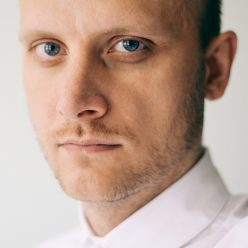
Denis Karagodin (Денис Карагодин) is an independent researcher working at the intersection of political history, social philosophy, archival studies, and media theory.
His research focuses on the structures of political power, ideology, and bureaucratic systems, as well as on the documentation and interpretation of political violence. A central dimension of his work is the analysis of media as an environment and structuring system through which political narratives, historical memory, and representations of state violence are produced, mediated, and contested within institutional frameworks and contemporary political conditions.
His research combines archival investigation, conceptual analysis, and media-based methodologies, with a particular emphasis on the relationship between documentation, narrative form, and knowledge production in the context of political and historical inquiry.
His work is inherently interdisciplinary, integrating approaches from philosophy, political science, media studies, and archival research.
His work contributes to the development of new investigative and analytical approaches to the study of political violence, archives, and media systems.
Research Areas
- Ideology and Power
- Bureaucracy and State Violence
- Law and Transitional Justice
- Archives and Historical Memory
- Media Theory and Political Narratives
- Mediation and Documentary Systems
- Aesthetics of Temporal Incompleteness
Education
Tomsk State University
MA in Philosophy
Faculty of Philosophy
Tomsk State University
Professional Program in Systems Analysis (Information Technology)
Continuing Professional Education
Publications
Published
Under Review
- STEPINQUEST®: Narrative as Action — An Investigative Narrative Form.
- Prohibiting What Has Already Become Part of the State.
- Click: When narrative begins to act.
- Node Above the Archive: A Counter-Monument in Infrastructure.
Essay
- The Principle of Non-Degradation: How to Live Online in Contemporary Russia
- The Black Vans Return
- Memory Wars: Mirroring Dynamics Between Russia and Europe
- To Save the NKVD Garage, Tomsk Removed a Memorial
Methodology
- The STEPINQUEST® Framework: A Global Language Intervention Now in Place
- A Node Is Placed at a Site of State Power
- A Position Is Established
- Node Above the Archive (Project Statement)
- KARAGODIN as Code
Current academic status
Denis Karagodin is currently seeking institutional affiliation and opportunities to pursue a PhD program in political science or related interdisciplinary fields in the United States.
Academic References
Letters of recommendation supporting Denis Karagodin’s research are available upon request by prominent Russian public intellectuals, including political scientist Ekaterina Shulman and, previously, the late political analyst Gleb Pavlovsky.
Academic Profiles
External platforms presenting Denis Karagodin’s academic profile, research activity, and institutional affiliations.
Primary Academic Identity
- Google Scholar (Research Profile)
- ORCID (Academic Identifier)
Indexing and Citation Databases
Research Repositories
Institutional Profile
Authority and Identity Records
- VIAF (Virtual International Authority File): 193148752133241201145
- Library of Congress (United States) — Electronic Resources Catalog (database record): Denis Karagodin
- National Library of Poland (BN authority record): (PL)a0000003577832
- MMS ID (library system identifier, catalog reference): 9810658221005606
Availability and Collaboration
Denis Karagodin is currently based in Russia and conducts independent research within this context. Holding both Russian and EU citizenship, he has full international mobility and is available for academic collaboration, institutional affiliation, visiting research positions, and interdisciplinary projects.
Academic collaboration
Information about current academic collaboration, conference plans, and related academic activities is available in the Academic Collaboration and Academic Activity sections.
Contact
For academic inquiries, research collaboration, or professional communication, please use the contact page.