
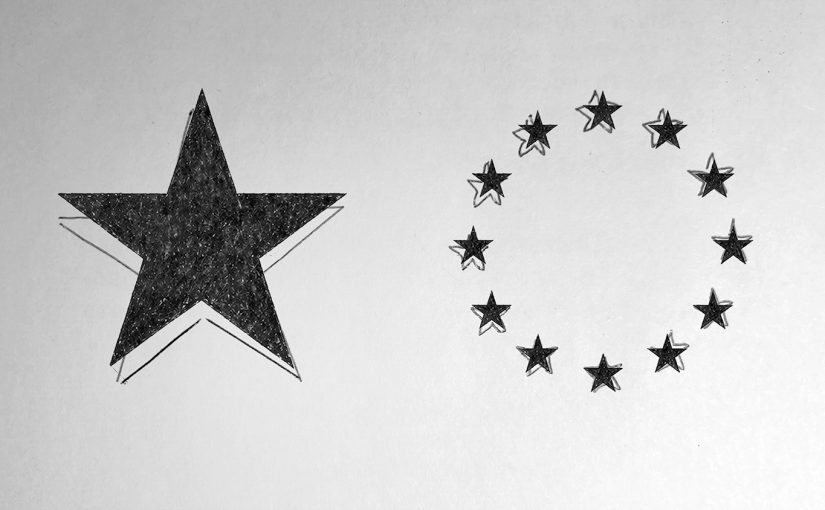
Conflicts over memory between states — and within them
Memory, Mirrored Asymmetry, and the Politics of Removal
The demolition of the Stone of Sorrow memorial in Tomsk marks another moment in the unfolding “memory wars” between Russia and Europe — a conflict in which struggles over monuments reflect deeper contestation over historical narratives, state identity, and the foundations upon which they are built.
On April 19, 2026, the Stone of Sorrow memorial in Tomsk — dedicated to the victims of Stalinist political repression — was dismantled, along with surrounding commemorative stones dedicated to repressed Kalmyks, Poles, Estonians, Latvians, and Lithuanians. The removal was carried out at night, with restricted access and limited public information; official statements were subsequently removed from municipal channels, prompting criticism from local residents.
The joint statement issued on April 23, 2026, by the embassies of Estonia, Latvia, Lithuania, and Poland in response to these developments places the event within a broader landscape of what might be described as “memory conflicts” across the post-Soviet space.
Over the past decades, the Baltic states have pursued policies aimed at reassessing — and in many cases removing — monuments associated with the Soviet period, a process that has generated recurring tensions since at least the 2007 relocation of the Soviet war memorial in Tallinn. These actions are typically framed as efforts to reshape public space in line with national historical narratives. They have also, predictably, provoked strong reactions from the Russian state, where such removals are often interpreted as acts of historical revisionism — particularly insofar as they are seen as rejecting a historical narrative, rooted in the Soviet past, that continues to inform elements of contemporary Russian national identity.
This dynamic, in turn, generates a corresponding response within Russia. Developments there point to a different, less formalized pattern. Memorials dedicated to victims of political repression — including those associated with foreign national communities — have increasingly come under pressure. In many cases, this pressure does not take the form of official policy but instead operates through indirect or procedural means: removal under administrative pretexts, acts of vandalism, or the gradual erosion of their public presence.
Within this broader dynamic, the case of Tomsk does not appear as an isolated or exceptional event, but rather as a continuation of the same underlying logic. It brings a critical distinction into focus: Soviet-era monuments in the Baltic states were erected under a different political system.
By contrast, many memorials dedicated to victims of repression within Russia — including those commemorating Lithuanians, Latvians, Estonians, Poles, and others — were established in the post-Soviet period, within the legal and institutional framework of the Russian Federation itself.
This distinction introduces an apparent asymmetry — one that, on closer examination, reveals a pattern of structural mirroring shaped by fundamentally different underlying logics..
The removal of Soviet monuments abroad can be framed, however controversially, as a reassessment of a previous regime — specifically, monuments installed during the Soviet period and often associated with policies of cultural assimilation, which many in the Baltic states view as part of a history of occupation and the suppression of national identity.
The dismantling of memorials within Russia, by contrast, concerns objects that were installed lawfully within the current state’s own legal order — primarily in the post-Soviet period, following the dissolution of the USSR and the establishment of diplomatic relations with the now-independent Baltic states.
At the same time, the two dynamics can be seen as structurally analogous, yet fundamentally asymmetrical: while the Baltic states frame their actions as a re-evaluation of a past regime, developments within Russia suggest a different logic, in which the Soviet period is treated as a continuous and legitimate historical foundation. This reflects, in part, the Russian Federation’s position as the legal successor to the Soviet Union, as well as the enduring role of the Soviet past in shaping elements of contemporary state identity. Within this framework, the memory of the Second World War occupies a central place, often functioning as a primary source of historical legitimacy and cohesion, particularly in contrast to earlier, more contested periods of Soviet history. As a result, interventions that touch upon this layer of memory — including those involving monuments and commemorative practices — can be perceived not merely as historical reinterpretations but as challenges to foundational narratives of the state itself.
In this sense, the Russian state can be seen as engaged in its own process of post-Soviet self-definition — one that, unlike in the Baltic case, remains closely anchored in the Soviet historical framework, which in turn may be perceived as being called into question by such acts — not only as a matter of historical interpretation, but as a challenge to the foundations of state identity itself. This raises a further question — not explicitly addressed in the joint statement — of where the present-day Russian state positions itself in relation to that past, and with which historical legacy it ultimately aligns. It is this asymmetry that the joint statement implicitly underscores by emphasizing the legality of the memorials’ establishment.
Seen within this framework, the demolition of the Tomsk memorial is not only a local event but a concrete site within a broader pattern of “memory wars,” where monuments themselves become objects of contestation. What unfolds is not simply a conflict between states but a series of asymmetrical responses shaped by fundamentally different understandings of historical continuity. In this dynamic, Tomsk appears not as an isolated case but as a point of contact — a place where these competing logics intersect and take material form within the institutional continuity of the state itself, revealing how struggles over the past are inseparable from ongoing processes of state self-definition.
From this perspective, the actions of the Baltic states and those unfolding within Russia appear less as opposing processes than as structurally analogous responses. In both cases, states engage in the ongoing construction of historical narratives that underpin contemporary identity, drawing boundaries around what is to be preserved, reinterpreted, or removed. The difference lies not in the presence of this process, but in its historical orientation and institutional framing. As such, the current intensity of these “memory wars” reflects a moment in which these boundaries remain unsettled — a condition unlikely to remain indefinitely stable, yet one that, in the present, produces increasingly visible and often disruptive outcomes.
At the same time, these conflicts remain grounded in human lives: both Soviet and anti-Soviet memorials are rooted in the lived experience of individuals — their lives, losses, hopes, and emotional realities — from which they emerged, and whose remembrance extends beyond the divisions that now shape their interpretation. Yet these same lives are often drawn into political confrontation, as states mobilize memory as an instrument within broader struggles over history and identity.
Such dynamics, sooner or later, as history repeatedly shows, give way to forms of settlement — with clearly defined boundaries, frameworks, and conditions of mutual restraint and respect.
One may hope that such a point will eventually be reached here as well.
Support
This work is produced as part of Denis Karagodin’s independent research and writing.
Its continuation is sustained over time through personal effort and, in part, through public support.
Further information: karagodin.com/donate
Discover more from Denis Karagodin
Subscribe to get the latest posts sent to your email.