

A history that exists, but is increasingly out of reach.
An analytical essay on legal reclassification, archival access, and the transformation of historical knowledge under conditions of institutional restriction.
Introduction
A legal designation intended to prohibit an organization does not stop at the organization itself. In practice, it extends to materials already integrated into state institutions.
Such reclassification reshapes access to archives and, with it, the conditions under which historical knowledge can be encountered, altering the boundary between what is preserved and what can be publicly accessed — including materials already embedded within the state itself.
A Legal Reclassification
On April 9, 2026, the Supreme Court of the Russian Federation issued a ruling that, at first glance, appeared administrative in nature. In formal terms, it designated Memorial — a network of independent civil society and human rights organizations — as an “extremist organization,” thereby prohibiting its activities across the entire Russian Federation. The decision entered into force immediately. No transitional period, no interpretive delay — the category was applied, and with it, an entire field of activity was reclassified.
In ordinary usage, the term “extremist organization” typically evokes violent groups, clandestine cells, or movements advocating force. In the Russian legal context, however, the designation has acquired a broader and more elastic meaning. It is routinely applied to civic initiatives whose activities are, in practice, nonviolent and legal. Once assigned, the label triggers a cascade of consequences: materials are banned, affiliations are criminalized, and the individuals involved are treated, in legal terms, as though they were participants in violent or terrorist activity. The gap between the formal designation and the empirical nature of the organization is not incidental; it is structural. The designation does not simply describe reality; it actively reorganizes it.
The Operational Logic of “Extremism”
Memorial itself occupies a distinct and, until recently, widely recognized place in Russian and international intellectual life. Emerging in the late Soviet period, it functioned as a decentralized network of researchers, activists, and local historians dedicated primarily to documenting the victims of political repression — most notably those of 1937–1938, the period commonly referred to as the Great Terror, when Stalinist policies resulted in the execution of hundreds of thousands of Soviet citizens. Over time, its scope expanded, but this original task — recovering names, reconstructing biographies, and assembling documentary evidence — remained central.
The Brief Window of Openness
The conditions that made this work possible were exceptional. In the 1980s and early 1990s, as the Soviet Union entered its final phase and ultimately collapsed, a brief window of archival openness emerged. For a limited period, access to previously closed state and security archives became, if not fully unrestricted, then at least negotiable. This moment coincided with a broader societal re-evaluation of the Stalinist past. It was within this opening that Memorial’s decentralized network carried out much of its foundational work.
What distinguishes these materials is not only their content but the way they were accumulated. They were gathered locally, often by non-professional historians working within their own communities. Interviews with survivors and relatives, personal letters, unofficial documents, photographs, and fragments of testimony were collected and systematized. Sometimes what survived was a single recorded recollection, a handwritten letter, or a family account of a night arrest that existed nowhere in official records. These were not merely supplements to official archives; they were, in many cases, the only surviving traces of events that had been either poorly documented or deliberately obscured.
Crucially, many of these materials were later transferred into state archival systems. Regional branches of Memorial deposited their collections in municipal and federal archives, as well as in libraries and museums, under the assumption that such integration would ensure both preservation and public accessibility. In a narrow technical sense, that assumption has proven correct. The documents remain preserved. But preservation, under current conditions, has come to mean something else.
The next phase, already implicit in the legal logic of the ruling, is the systematic restriction of access to these materials. If an organization is designated as extremist, then its outputs — documents, databases, testimonies — become, by association, problematic. Even when physically housed within state institutions, they can be removed from public circulation, reclassified, or rendered accessible only under highly controlled conditions.
The same logic extends to digital infrastructures through which these materials have been disseminated. Online archives, databases, and institutional websites associated with Memorial are likewise subject to restriction — whether through direct removal, blocking, or other forms of controlled inaccessibility. In this sense, the question is no longer where the archive is stored, but under what conditions it can be reached.
The archive, in this configuration, becomes a sealed space: intact, catalogued, and effectively unreachable.
What is being restricted, therefore, is not the archive itself but the conditions under which it can be encountered.
For researchers, this represents not merely an inconvenience but an epistemic contraction. The value of Memorial’s collections lies precisely in their status as primary sources — often the first recorded versions of personal histories that later informed or corrected official records. Without access to these materials, the historian is left with a thinner, more formalized, and ultimately less reliable archive. What disappears is not only information but the texture of historical reality: the inconsistencies, the voices, the margins where official narratives are tested against lived experience.
The implications extend beyond individual collections to the broader ecology of knowledge production. Memorial’s work was fundamentally decentralized. It relied on a dispersed network of local initiatives, each contributing fragments that, when combined, formed a complex and multi-layered picture of the past. To designate this entire mode of activity as extremist is, retrospectively, to invalidate a particular way of knowing — one that resists centralization and depends on the accumulation of small, locally grounded truths.
When Legal Categories Meet Institutional Reality
A revealing illustration of the resulting ambiguities can be found in the city of Tomsk. There, a former NKVD investigative prison — an actual site of interrogation and confinement during the period of Stalinist repression — was transformed into a museum dedicated to this history. The initiative originated within the local Memorial organization, whose members collected and curated much of the material. Over time, the institution was incorporated into the Tomsk Regional Museum, becoming part of the official cultural infrastructure.
Today, the museum’s exhibitions and digital presence are largely built upon collections originally gathered by Memorial. Yet the organization that produced these materials is now classified as extremist. The situation produces a quiet but consequential institutional paradox. The logic of the designation, when applied in practice, produces outcomes it cannot fully accommodate. The case is not exceptional; it is illustrative. A state museum, operating under official auspices, displays content generated by an entity whose activities are, in principle, prohibited. The boundary between the sanctioned and the forbidden is not simply blurred; it has, in practice, already been crossed and absorbed.
This extends to the digital domain as well, where publicly accessible materials remain online while their originating context has been legally prohibited.
There is a certain historical irony in this. Materials that were once transferred to state institutions in the belief that they would be safeguarded for public use are now indeed safeguarded — but in a form that increasingly excludes the public. The archive is secure, but it is no longer a shared space. It exists, one might say, in a condition of suspended visibility: present, indexed, and inaccessible.
The events of 1937–1938 — the Great Terror — remain one of the most violent episodes in twentieth-century Russian history. The systematic execution of Soviet citizens by NKVD officers produced not only a vast number of victims but also a fragmented and uneven documentary record. Memorial’s contribution was to assemble, piece by piece, a counter-archive: one that restored names, contexts, and narratives to what might otherwise have remained statistical abstractions.
To remove this counter-archive from public access is to alter the conditions under which the past can be known. It does not erase history; the documents persist. But it reshapes the horizon of inquiry. What becomes more difficult is not the existence of evidence but its circulation — its ability to enter public discourse, to be compared, contested, and interpreted.
In this sense, the ruling of April 9, 2026, marks more than a legal development. It signals a transition in the relationship between the state, the archive, and the public. The past is not destroyed; it is contained — and containment, in the realm of historical knowledge, can be as consequential as erasure.
One is left, finally, with a simple but disquieting image: the documents persist, but their horizon of access contracts — an archive that remains meticulously preserved, yet no longer presupposes a public. In this configuration, what has already been absorbed into the institutional structure is reclassified in terms that render it, in principle, prohibited.
Update
(April 10, 2026)
The Memorial database of NKVD personnel (1935–1941), a continuously updated resource, has become inaccessible following the organization’s designation as extremist by the Supreme Court of the Russian Federation.
This development illustrates the process described above: historical knowledge remains, while access to it becomes increasingly restricted.
The database may reappear on servers outside the Russian Federation; however, access to it would remain restricted within Russia due to its association with an organization designated as extremist.
(April 19, 2026)
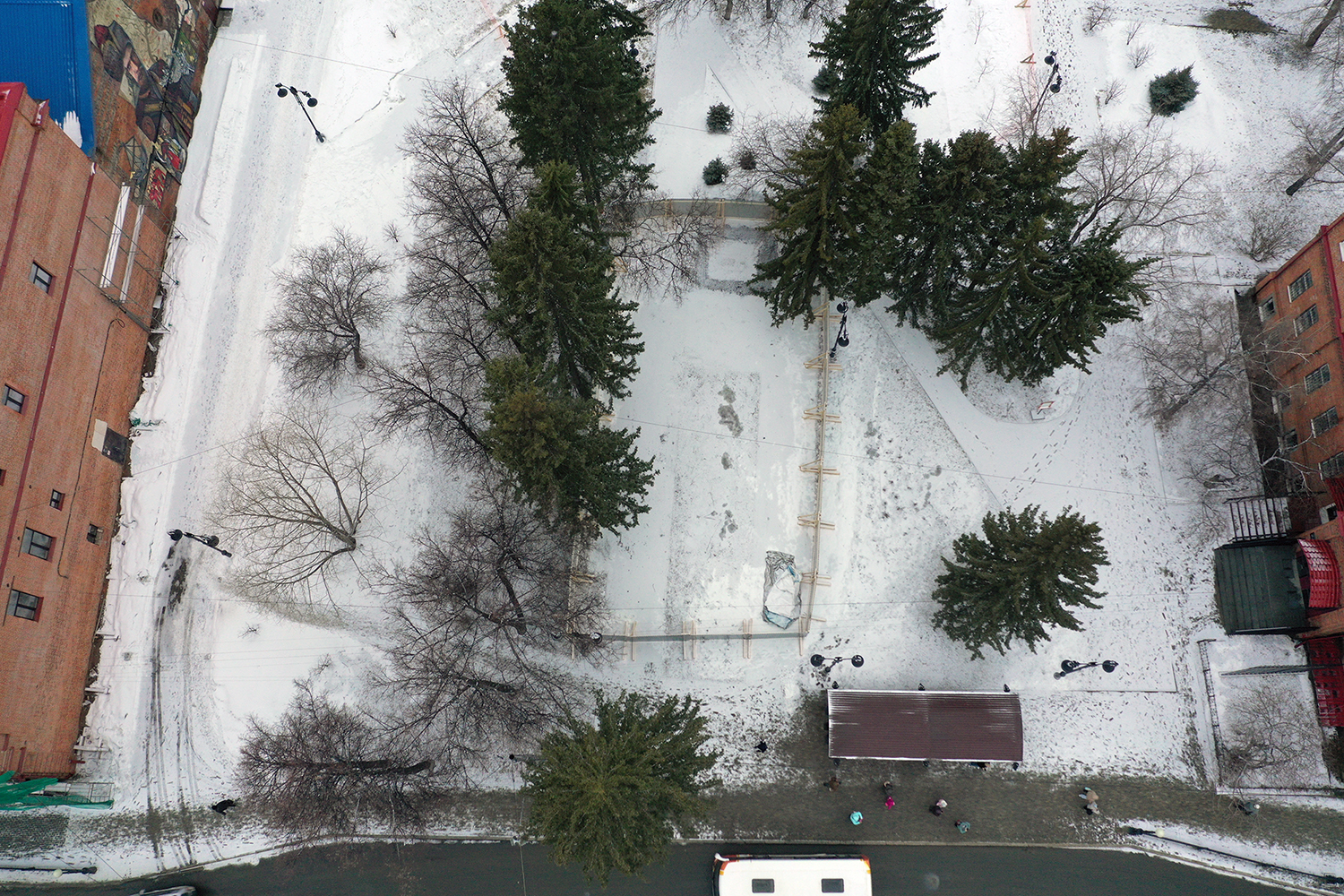
The consequences of this reclassification extend beyond the archival domain, becoming visible in the physical and symbolic structure of the city itself. In April 2026, a memorial to the victims of Soviet political repression — the Stone of Sorrow, installed in the early 1990s with the participation of Memorial — was dismantled in a public square directly facing the Tomsk city administration. The site is framed by two former NKVD buildings: one now housing a museum of repression, the other repurposed for civic use.
The official justification cited a risk of structural collapse allegedly posed by nearby garages. These garages are not incidental structures. They form part of the same institutional infrastructure: historically, they served the operational needs of the Tomsk NKVD and were used during the Great Terror, including for the transport of arrested individuals — the so-called “black vans.” In altered institutional form, this infrastructure remains active today within the system of the Ministry of Internal Affairs.
What is presented as a matter of safety thus reveals itself as something else. The removal of the memorial is carried out through the very infrastructure that once enabled repression. The argument of infrastructure functions not as explanation, but as mechanism: it relocates responsibility into a technical register while preserving the continuity of the underlying system.
The dismantling of the monument does not erase history. It exposes the process itself. What is being removed is not only a physical marker, but a point of direct public testimony. At the same time, the infrastructure invoked to justify its removal points back to the same institutional field — one that can be traced, documented, and named.
The result is not disappearance, but transformation: memory is displaced from visible form into a structure that continues to produce it in another way — through the persistence of institutions, spaces, and the actors who operate within them.
Source
The original version of this text is published at:
https://karagodin.com/?p=15268
A formatted PDF version of the document is available at:
The online version serves as the primary reference; the PDF provides a fixed document format.
Discover more from Denis Karagodin
Subscribe to get the latest posts sent to your email.